

• Airplane Lights: The Definitive Guide to Commercial Aircraft Exterior Lighting

To the untrained eye, the constellation of airplane lights traversing the night sky might look like a purely aesthetic arrangement of colored flashes.

However, in both commercial aviation and flight training, every illumination point is strictly regulated by international frameworks to ensure operational safety, communication, and traffic separation.

Exterior lights systems in aircraft act as critical visual components. They provide necessary situational awareness for the flight crew during dynamic phases of flight and allow air traffic controllers and other aircraft to identify a plane’s position, heading, and operational status.

Below, we break down the technical specifications, ICAO standards, and operational protocols of airplane lights across the global airspace.
Classification of Airplane Lighting Systems

To maintain absolute uniformity across global airspace, the International Civil Aviation Organization establishes strict standards for core signaling systems.

According to ICAO Annex 6, aircraft operating during low-visibility conditions or between sunset and sunrise must display two primary categories of exterior lighting: position lights and anti-collision lights.

Position Lights

Position lights are the fundamental tool used to determine an aircraft’s relative heading and flight path. This system relies on a globally standardized, color-coded sector layout:

🔴 Left Wing: A steady, continuous red light covering an exact forward arc of 110 degrees from the aircraft’s nose.

🟢 Right Wing: A steady, continuous green light covering an exact forward arc of 110 degrees from the aircraft’s nose.

⚪️ Tail Cone / Trailing Edges: A steady, continuous white light covering a rearward arc of 140 degrees.

The interlocking sectors of these three steady beams span a full 360-degree perimeter around the fuselage, eliminating visual blind spots. By observing the geometry of these colors, pilots and ground controllers can instantly determine a traffic’s orientation.

For instance, if a flight crew spots an aircraft ahead showing a green light to the left and a red light to the right, they know immediately that the traffic is on a direct head-on approach, allowing them to take prompt traffic separation maneuvers.

Anti-Collision Lights

Designed to actively capture attention across vast distances, the anti-collision system utilizes high-intensity flashing mechanisms. Under standard certification rules, this block consists of two distinct subsystems:

Beacon Lights

Beacon lights are omnidirectional, pulsing red (or aviation orange) lights positioned on the upper and lower centerlines of the fuselage. They serve a vital safety purpose both in flight and during ground handling:

  1. In Flight: They provide a continuous, high-visibility warning signal to prevent close-proximity conflicts.
  2. On the Ground (Ramp Safety Protocol): The activation of the red beacons is the universal warning that the aircraft’s engines are either spinning or about to start. Airport ramp agents, marshallers, and support vehicles are strictly prohibited from approaching the safety envelope of the airframe while these lights are pulsing.

Strobe Lights

Strobes are ultra-high-intensity, flashing white lights located on the outermost trailing edges of the wingtips and, on many airliners, the tail cone.

Powered by modern high-discharge LED arrays or specialized xenon gas tubes, their quick bursts are designed to maximize aircraft conspicuousness across miles, even when flying through dense clouds, haze, or fog.

Because their brilliance can cause severe temporary glare, flight crews follow a strict standard operating procedure (SOP): strobes are only switched on when crossing the hold-short line onto an active runway for takeoff, and they are turned off immediately after exiting the runway upon landing.

Task-Specific Airplane Lights Systems

While signaling systems are legally required to make the aircraft visible to others, flight crews rely on a separate suite of high-powered forward and lateral lights to illuminate their path and monitor airframe integrity during specific operational phases.

Taxi and Runway Turnoff Lights

Taxi Lights

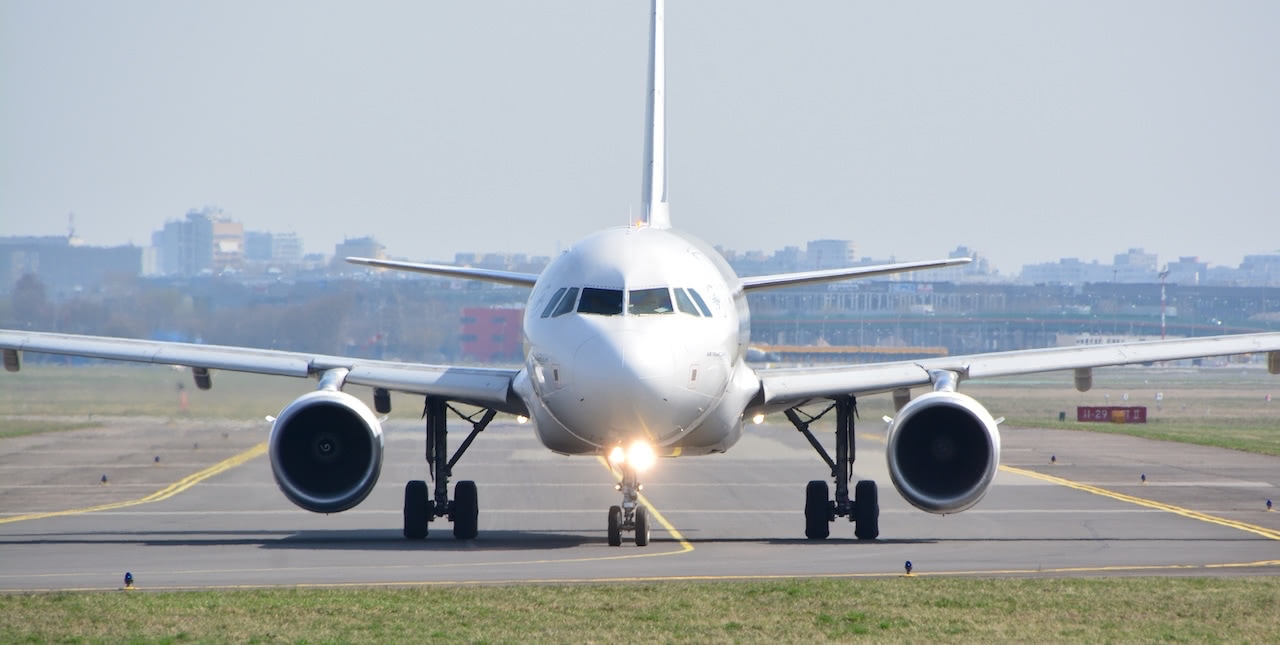
Mounted directly on the nose gear strut, taxi lights emit a narrow, fixed white beam designed to illuminate the centerlines of airport taxiways.

Their power output and focal range are optimized for medium-distance ground maneuvering, ensuring safe navigation between the terminal gate and the active runway.

Runway Turn-off Lights

To complement ground operations, commercial airliners feature runway turnoff lights. These fixtures are located on the wing roots or nose section, angled outward at approximately 50 degrees from the aircraft’s longitudinal centerline.

Their role is to cast a wide, horizontal flood of light into dark intersections, high-speed turnoffs, and runway exits, allowing the flight crew to clearly spot the pavement edges and any potential ground hazards before initiating a turn.

Landing Lights

Airplane landing lights are the most powerful illumination systems on board, frequently reaching outputs between 400 and 600 watts per lamp.

Depending on the aircraft manufacturer, they are integrated into the inboard wing leading edges, the nose gear strut, or housed in retractable belly compartments beneath the fuselage.

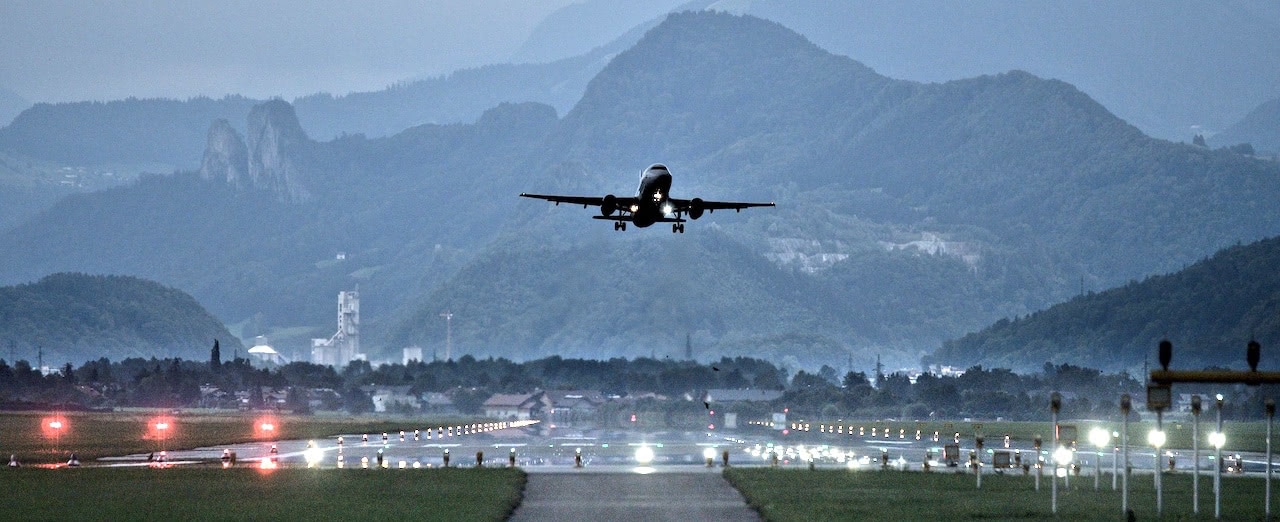
Their primary task is to completely illuminate the runway environment during the high-speed dynamics of takeoff runs and final approaches, ensuring a smooth, precise flare and touchdown. In this phase, the aircraft’s forward lights interface seamlessly with the airport lighting to secure the approach path.

Beyond lighting up the runway surface, an international aviation convention dictates that landing lights should remain illuminated throughout the climb and descent phases whenever the aircraft is operating below 10.000 feet (approximately 3.000 meters). This acts as an effective passive safety measure, significantly increasing the visual cross-section of the aircraft within congested terminal areas.

Wing Inspection and Logo Lights

To achieve comprehensive external visibility, two final optional systems round out the airplane’s lighting layout:

Wing Inspection Lights

These are flush-mounted floodlights located on the sides of the fuselage, precisely aimed at the wing leading edges and engine nacelles. Their function is to allow visual checks at night to detect dangerous ice accretion over the aerodynamic surfaces.

Logo Lights

Positioned on the upper surfaces of the horizontal stabilizer, these lights project upward to illuminate the airline emblem on the vertical tail fin.

While they provide excellent brand visibility, their primary safety purpose is to outline the true scale and height of the tail section, making the aircraft highly visible to other traffic on crowded taxiways and aprons.

Functions, Colors, and Operating Protocols of Aircraft Lighting Systems

Functions, Colors, and Operating Protocols of Aircraft Lighting Systems
LIGHT TYPELOCATIONCOLORBEAM TYPEOPERATIONAL PHASESAFETY FUNCTION
POSITIONWingtips and tail coneRed (left 110º)
Green (right 110º)
White (tail 140º)
SteadyFrom initial flight deck energization until total aircraft shutdown.Indicates relative position, orientation, and heading vector during night operations.
BEACONFuselage upper and lower centerlinesRedPulsing / FlashingActivated prior to engine start; deactivated after complete engine shutdown.Prevents ramp incursions and ground accidents; signals active or starting engines.
STROBEOutermost wingtips and tail coneWhiteHigh-intensity flashingSwitched on when entering an active runway; switched off immediately upon vacating.Maximizes aircraft conspicuousness at long distances under all weather conditions.
TAXINose gear strutWhiteSteady (Narrow beam)Used during autonomous ground maneuvering along airport taxiways.Illuminates the taxiway centerline and signals aircraft ground movement.
RUNWAY TURNOFFWing roots or nose sectionWhiteSteady (Wide beam, 50º outward angle)Used during night taxiing, specifically when approaching intersections and sharp turns.Illuminates taxiway edges and track margins prior to initiating ground turns.
LANDINGWing leading edges, fuselage, or nose gearWhiteUltra-high intensity (Up to 600W)Mandatory for takeoffs, final approaches, and operations below 10,000 feet.Ensures runway visibility during takeoffs/landings; increases aircraft cross-section.
WING INSPECTIONLateral fuselageWhiteSteadyActivated at flight crew discretion during suspected night icing conditions.Allows visual monitoring of ice accretion or structural damage on wing leading edges.

Passenger Cabin Dynamics:

Dimming Interior Lights for Landing

A common question among frequent flyers is why cabin crews dim the interior cabin lighting during night takeoffs and landings, considering that these protocols coincide with the activation of the exterior airplane lights.

This procedure is a strict operational safety standard. Takeoffs and landings represent the most critical, high-workload phases of flight. By dimming cabin lights, the human eye is given time to naturally adapt to the darkness outside the windows.

In the rare event of an unexpected landing incident requiring an emergency evacuation, both passengers and cabin crew will already possess full night-vision adaptation.

This allows for immediate orientation toward the emergency exits and the floor-level photoluminescent escape paths without losing vital seconds waiting for the eyes to adjust to the dark exterior environment.

Launch Your Career in the Aviation Industry

Mastering aircraft lighting systems is a vital part of a professional pilot’s education. From standard position indications to advanced automated flight deck configurations, understanding your aircraft is what sets elite aviators apart.

At One Air, E-ATO 190 flight training academy, we train our students through a comprehensive curriculum that blends advanced theoretical knowledge with real-world flight operations.

Are you ready to take command of your future? Discover our Commercial Pilot ATPL Courses and find the ideal program to launch your career. Contact our admissions team today for a personal consultation!

You may be interested…