• All about TCAS or Traffic Collision and Avoidance System

Have you ever looked up at the sky, seen two planes cross paths and wondered how they didn’t collide? It’s not magic or chance, it’s TCAS.

Today, we are going to talk about one of the most important pieces of modern aviation safety: the Traffic Collision and Avoidance System, colloquially known as TCAS.

Join us on this flight to find out what it is, how it works and why mastering this system is an essential step on your way to becoming a commercial pilot.

What is TCAS in aviation? The watchman in the sky

Imagine you are flying an airliner at 35,000 feet. The sky seems immense, but in reality, air routes are like invisible highways that can become very busy.

TCAS, which stands for Traffic Collision Avoidance System, is the system that allows us to navigate these highways with maximum safety.

Simply put, TCAS is an on-board electronic system that operates independently of air traffic control (ATC) on the ground. Its sole mission is to detect the presence of other nearby aircraft and, if there is a risk of collision, to provide pilots with clear and precise collision avoidance instructions.

It is not just a detector; it is a proactive system. It doesn’t just say ‘look out, there’s another plane’, it coordinates an evasive manoeuvre in the air, making sure that if one plane goes up, the other goes down.

Origins of TCAS

Aviation has always been in constant revision of procedures, with the aim of learning from past mistakes so as not to make them in the future. In this sense, aviation safety has evolved enormously.

But it was not until 1956, when a United DC-9 and a Lockheed L-1049 collided while flying over the Colorado Canyon (USA), that the imperative need for an on-board prevention system became evident.

Transponder information was then used to investigate incidents, and later, in 1981, the FAA announced the development of an specific collision avoidance system. Welcome to the world, TCAS!

So, how does TCAS work?

TCAS communicates with the transponders or Secondary Surveillance Radars (SSRs) of other nearby aircraft to obtain their altitude and trajectory.

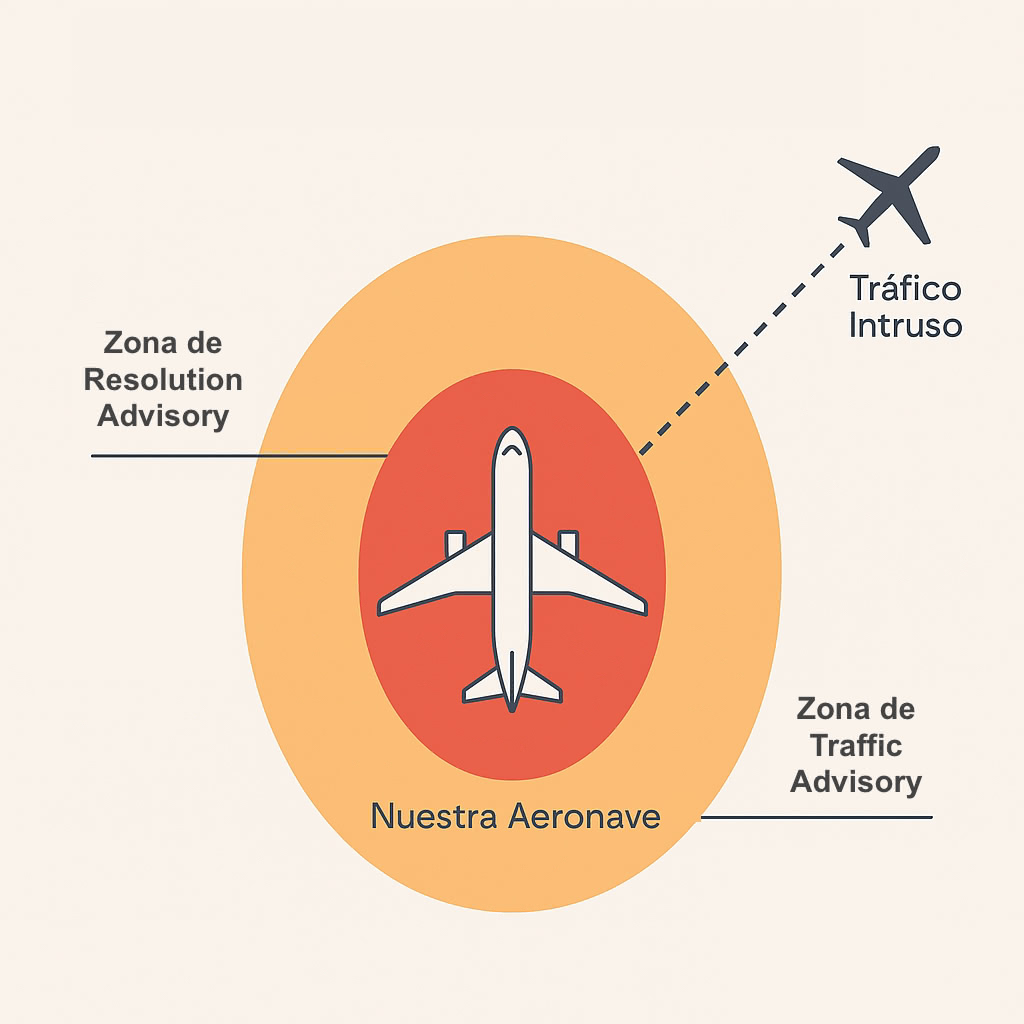
When it detects a potential conflict, it acts in a tiered logic so as not to create unnecessary stress in the cockpit. These are the two levels of warning:

1. Traffic Advisory (TA)

This is the first level of alert. It occurs when another aircraft is approaching and could become a threat in about 35-45 seconds.

It sounds: «Traffic, traffic».

At this point, you do not have to make any manoeuvres. The instruction is to look visually for conflicting traffic and be prepared to react if the situation worsens.

2. Resolution Advisory (RA)

This is the most critical warning and requires immediate action.

It occurs when a collision could happen within 20-30 seconds. TCAS calculates a vertical avoidance manoeuvre and gives a clear and concise command to the pilot.

It sounds: «Climb, climb!», «Descend, descend now!»; or even «Adjust Vertical Speed, Adjust».

Thanks to the Mode S transponder, which allows communication and ‘data link’ between aircraft, the system is collaborative, i.e. if one aircraft is ordered to climb, the other will be ordered to descend, ensuring safe separation.
Symbols on the TCAS display

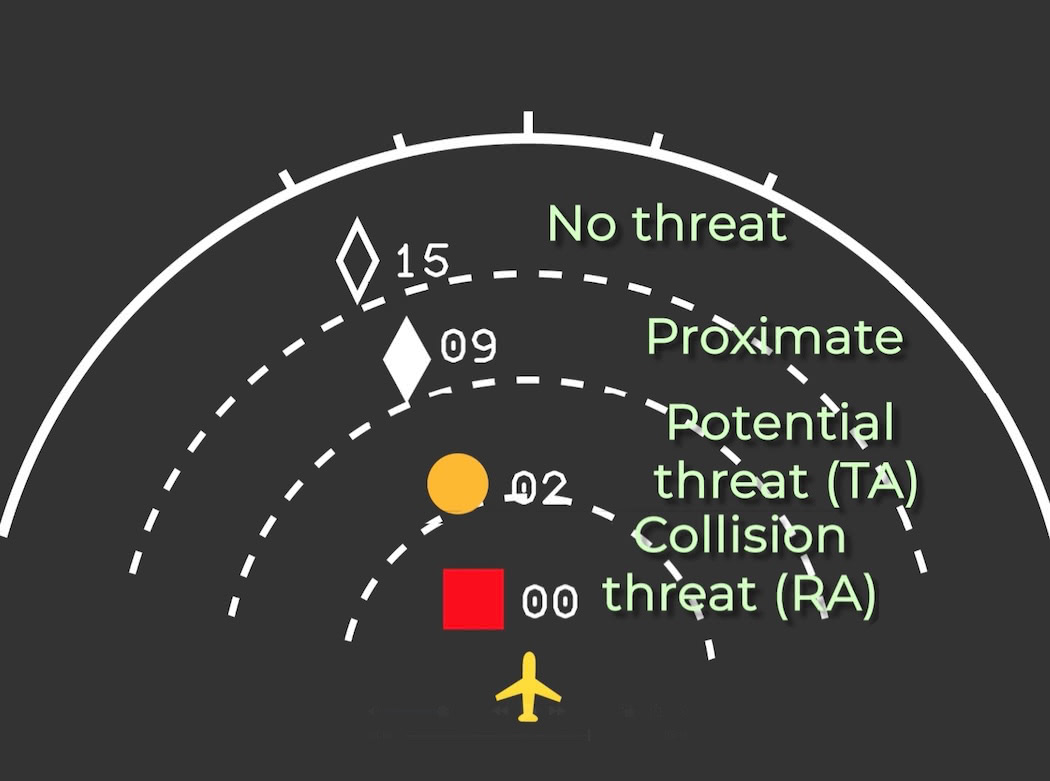
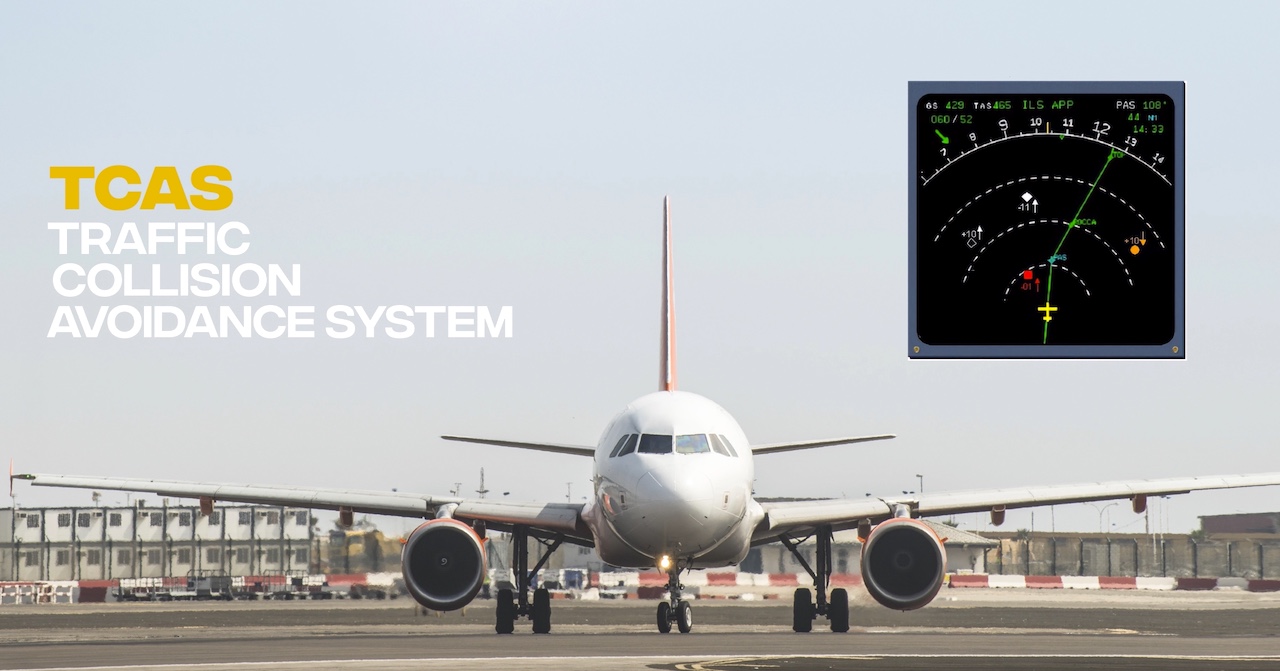
On the Navigation Display, TCAS represents nearby aircraft with specific symbols and colours.

Hollow Rhombus: Represents other non-threatening traffic.

🔹 Solid Rhombus: Nearby traffic that has approached the TCAS observation radius.

🟠 Solid Circle: Traffic Advisory (TA)! The aircraft symbol turns into a yellow circle. This is the visual signal that accompanies the audible ‘Traffic, Traffic’ alert.

🟥​ Solid Square: This is a Resolution Advisory (RA)! The conflicting aircraft is shown as a red square. It indicates that TCAS is giving an immediate evasive manoeuvre order.

In addition, on the vertical speed indicator (VSI), the TCAS will display green and red arcs. The green arc indicates the rate of climb or descent that the pilot must follow to comply with the RA, while the red arc shows the rates to avoid.

ATC vs TCAS: Who to obey?

Quick answer: The TCAS order always takes precedence.

Why: Because TCAS reacts based on real-time and direct data from the other aircraft, i.e. it has all the possible context of the situation and is much quicker and more accurate in critical situations.

In contrast, the ground controller’s radar is not seeing the three-dimensional scope of the situation and its response does not offer a reliable and safe solution.

Of course, once the conflict is resolved, the pilot must notify ATC of the deviation and the reason for it.

Types of TCAS: How many are there?

Although there are several versions, the systems are mainly divided into two categories:

TCAS I

This is the most basic system. It only provides Traffic Advisories, but does not offer manoeuvring solutions. It is common in smaller aircraft or in general aviation.

TCAS II

The standard in commercial aviation. It not only detects and advises (TA), but also issues vertical resolution (RA) commands, coordinating with the other aircraft.

In order for TCAS to function properly, the aircraft must have SSR emitting in mode C and two antennas: one located on the top of the fuselage, which acts as a directional antenna; and one on the bottom, which acts as an omnidirectional antenna.

Why two antennas? The upper directional antenna focuses on conflicting traffic to accurately calculate its course, while the lower omnidirectional antenna ensures detection in a 360-degree radius.

ACAS X: The ultimate TCAS

The FAA and other international organisations are already progressively implementing the successor to TCAS II: the ACAS X.

This new generation system is capable of coordinating more complex and adaptive RA, including horizontal manoeuvres (turns), resulting in a much more intelligent and flexible tool.

But how does it do this? ACAS X integrates information from multiple sources, not just the transponder, and is designed for safe drone (UAS) operation in shared airspace.

By using a probabilistic model and advanced algorithms to analyse the entire environment, it is able to offer even more optimised and safer solutions.

Frequently asked questions about TCAS

Is it mandatory?

Yes, according to EASA regulations, TCAS II is mandatory for all civil aircraft with a maximum take-off weight of more than 5,700 kg or authorised to carry more than 19 passengers.

What happens if one aircraft has TCAS and the other does not?

If one aircraft has TCAS and the other only has a transponder, the system will be able to detect it and issue a TA. What it will not be able to do is coordinate an RA, as the other aircraft cannot “respond” to the command.

What happens if the TCAS of two aircraft get it wrong and give a contradictory order?

This is impossible by design. The TCAS systems of both aircraft communicate and coordinate with each other before issuing an RA.

If one system decides that an ASCEND is the best action, it will ensure that the other aircraft’s system issues a corresponding DESCEND command, ensuring a safe resolution.

Can a pilot ignore a TCAS warning?

A Traffic Advisory (TA) is informative. However, a Resolution Advisory (RA) is mandatory. Pilots are trained to follow an RA immediately and accurately, as it represents the safest solution calculated in real time to avoid a collision.

Start flying now with One Air

TCAS is just one of the many systems you will master on your way to becoming a pilot – it’s amazing how technology and the human factor make air travel the safest mode of transport in the world!

Do you want to get behind the controls too? Well, this journey begins with a first step: an excellent training.

At One Air we offer you the knowledge, the simulators and the fleet you need for your dream to take off. Request personalised information to start your ATPL Commercial Pilot Course. Your seat in the cockpit is waiting for you!

You may be interested…