

Andalusia Airports Guide: Why Southern Spain is Europe’s Prime Aviation Hub

Southern Europe’s airspace has a clear heavyweight champion: the Andalusian airport network.

While our region is globally famous for its tourism, for those of us in the aviation industry, it represents something far more critical: a high-level logistical and operational hub within the Aena network.

For aspiring pilots and industry professionals, understanding the scale of this infrastructure is vital. It’s not just about passenger numbers; it’s about the complexity, the diversity of approaches, and the operational reality of commercial aviation in Spain.

In this breakdown, we’ll analyze the current landscape of Andalusia’s airports, the record-breaking traffic stats, and—crucially for our international students—why this infrastructure makes Southern Spain the ultimate classroom for flight training.
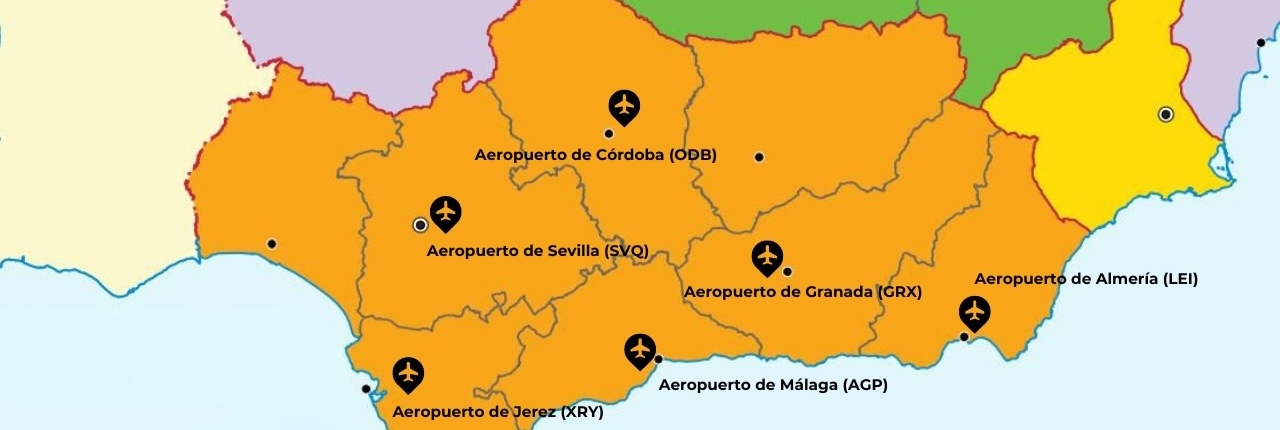

How Many Airports Are There in Andalusia?

The technical answer depends on the type of operation you are looking for.

If we are talking strictly about commercial facilities integrated into the Aena network, the region boasts six major international airports and one strategic heliport:

  1. Málaga-Costa del Sol Airport (AGP / LEMG)
  2. Seville Airport (SVQ / LEZL)
  3. Jerez Airport (XRY / LEJR)
  4. Granada-Jaén F.G.L. Airport (GRX / LEGR)
  5. Almería Airport (LEI / LEAM)
  6. Córdoba Airport (ODB / LEBA)
  7. Algeciras Heliport (AEI / LNR)

However, for pilots, the map is much richer. Beyond these passenger hubs, Andalusia is home to an extensive network of general aviation aerodromes (such as La Axarquía in Vélez-Málaga, Antequera, Trebujena, or Beas de Segura).

These smaller airfields are the lifeblood of general aviation and are absolutely essential for advanced pilot training. They allow students to master fundamental skills before transitioning to the complex, controlled airspace of the major international hubs.

The Andalusian Airport Network in Detail

Málaga-Costa del Sol Airport (AGP / LEMG)

After smashing records in 2025 by breaking the 25 million passenger barrier, Málaga has cemented its status as the fourth busiest airport in Spain.

For a student pilot, AGP is the “big leagues”. Its two runways (13/31 and 12/30) operate in a coordinated system to handle high-density traffic, including direct wide-body routes to the USA (United Airlines) and the Middle East (Qatar, Etihad).

It is the nerve center for commercial aviation in the south and offers a complex environment for advanced flight training.

Seville Airport (SVQ / LEZL)

With over 8.8 million annual travelers, Seville strikes a unique balance between low-cost carrier traffic and high-end corporate connections.

What makes SVQ unique is its industrial DNA. Located next to the Airbus final assembly line, operating here means sharing the sky with military transport test flights (like the A400M).

It adds a technical layer to the operational environment that few other places in Europe can offer.

Granada-Jaén Federico García Lorca Airport (GRX / LEGR)

Located in Santa Fe, this airport has seen a remarkable revitalization, surpassing 1.2 million passengers.

For future pilots, GRX offers something invaluable: orography. Flying approaches here involves navigating the proximity of the Sierra Nevada mountains.

It’s an enriching operational setting that teaches pilots how to manage performance and situational awareness in varied terrain.

Jerez Airport (XRY / LEJR)

A key reference in the province of Cádiz, Jerez is closing in on the 1 million passenger mark.

Beyond its seasonal commercial traffic, Jerez is historically significant for aeronautical instruction. The combination of excellent visibility and moderate commercial congestion makes it a favorite for practicing instrument approaches (IFR) without the intense holding patterns often found at busier hubs.

Almería Airport (LEI/LEAM)

Strategically located between the coast and the Sierra Alhamilla, Almería maintains a solid flow of 840,000 passengers.

Why do pilots respect LEI? The wind. The specific microclimate often presents challenging crosswind conditions, making it an excellent testing ground for refining pilot handling skills and crew coordination.

Córdoba Airport (ODB/LEBA)

After years dedicated primarily to general aviation, Córdoba has successfully reactivated regular commercial operations. Thanks to runway extensions and modernized navigation systems, it is now a growing node connecting the center of the region.

Algeciras Heliport (AEI/LNR)

While not a fixed-wing airport, its relevance is massive. It serves as the rapid link between the Peninsula and Ceuta (North Africa). For rotary-wing operations, this is a high-density environment crucial for emergency services and passenger transport.

2025 Air Traffic Statistics: A Sector on the Rise

The aviation sector in Andalusia isn’t just recovering; it’s expanding. The following table highlights the traffic data at the close of the 2025 fiscal year, showcasing the vitality of the region.

What do these figures mean for an international student? High passenger numbers translate to active, controlled airspace. Training here means you log hours in a “real-world” commercial environment, not just in empty skies.

Total number of passengers at different airports in Andalusia and annual rate of change.
AirportTotal Passengers (2025)Annual Variation
MÁLAGA (AGP)25.2 Million+10,4%
SEVILLA (SVQ)8.8 Million+9,2%
GRANADA (GRX)1.25 Million+15%
JEREZ (XRY)995,000+6,1%
ALMERÍA (LEI)840,000+4,8%
CÓRDOBA (ODB)135,000+280%

Frequently Asked Questions About Andalusian Airports (FAQ)

Which is the largest airport in Andalusia?

Without a doubt, Málaga-Costa del Sol (AGP). It leads in surface area, number of terminals, cargo volume, and passenger traffic. Its infrastructure is capable of handling wide-body aircraft (like the A350 or B777) for transatlantic operations.

Which is the oldest airport?

While aviation kicked off simultaneously across the region, Málaga Airport (founded in 1919) holds the title for the longest uninterrupted commercial operation, serving as a pioneer in Spanish civil aviation.

Which nationalities fly here the most?

In 2025, the United Kingdom remains the primary feeder market for Málaga, exceeding 5.5 million travelers (a key benefit for English-speaking students). In Seville, France and Italy share the top spot for international connections.

Which Andalusian airport is best for pilot training?

The best training doesn’t happen at a single airport—it happens across a network. The combination of intense international traffic at Málaga, the industrial context of Seville, and the accessibility of general aviation aerodromes like La Axarquía gives One Air students a competitive edge. You learn to handle everything from uncontrolled VFR flights to complex IFR procedures in heavy traffic.

Why Andalusia is the Best Place to Launch Your Pilot Career

The sustained growth of Andalusian airports is no accident.

It is the result of a perfect storm for aviation: exceptional meteorology (over 300 flying days a year) and a state-of-the-art infrastructure network. This makes our region, arguably, the best location in Europe for flight training.

At One Air, we see the demand for pilots rising in parallel with Aena’s statistics. Training in an environment with real commercial traffic, international procedures, and varied orography provides the most complete preparation a cadet can receive. You aren’t just learning to fly; you are learning to operate within the European commercial system from Day One.

Ready to take the left seat? If you are considering to become a commercial pilot, come to where the action is. Discover our flight programs in Málaga and start your journey in the heart of European aviation.

You may be interested…

