• First Solo Flight: Requirements, Procedures, and What to Expect When Flying Solo

In professional aviation, the first solo flight represents the defining rite of passage: the first time a student pilot operates an aircraft entirely on their own, from takeoff through the traffic pattern to a safe landing.

Beyond the surge of adrenaline, this milestone officially logs your initial entry as Pilot in Command (PIC). It confirms that your flight instructor has full confidence in your situational awareness, stick-and-rudder skills, and decision-making under real operational conditions.

What Exactly Is a Student Pilot’s First Solo Flight?

In everyday flight school conversation, “sending a student solo” means your flight instructor steps out of the aircraft, leaving you in sole control. While popular culture surrounds the event with high emotion, the solo flight is a strictly standardized, safety-focused technical exercise.

You are not departing on a long-distance cross-country flight. Instead, you will fly one or more standard visual traffic patterns (touch-and-goes or full-stop circuits) within your base aerodrome’s controlled airspace.

Every leg requires precise airspeed management, active radio coordination with Air Traffic Control (ATC), and stable glidepath control down to the runway touchdown zone.

When Does the First Solo Happen? Flight Hours and Regulatory Benchmarks

Aspiring commercial pilots frequently ask: How many flight hours does it take to go solo?

Under European Union Aviation Safety Agency (EASA) regulations, there is no arbitrary hour count set in stone. Progression relies entirely on student proficiency, consistency, and instructor endorsement.

However, across structured EASA Integrated and Modular ATPL programs, the average sits predictably between 12 and 20 dual instruction flight hours.

Mandatory Regulatory Prerequisites (EASA Standards)

Before clearing you to line up solo on an active runway, flight academies and civil aviation authorities enforce strict legal baselines:

  • Minimum Age: You must be at least 16 years old to log a solo flight (as outlined under EASA Part-FCL.020).
  • Medical Fitness: You must hold a valid EASA Class 1 Medical Certificate (for commercial tracks) or Class 2 (for private pilot training).
  • Passing the Flight Preparation Course (FPC): A course covering flight operations alongside basic technical knowledge and aircraft performance for the fleet the student pilot will operate. Once completed, the simulator phase begins, comprising 8 two-hour sessions dedicated to practicing pre-flight procedures and flight maneuvers.
  • Dual flight landing and endorsements: Complete at least one landing on a wide runway under dual flight instruction, and obtain favorable progress reports from two different flight instructors.

Operational Core Competencies Evaluated by the Instructor

Your instructor does not sign you off based on gut feeling. Clear performance criteria must be proven across multiple flights:

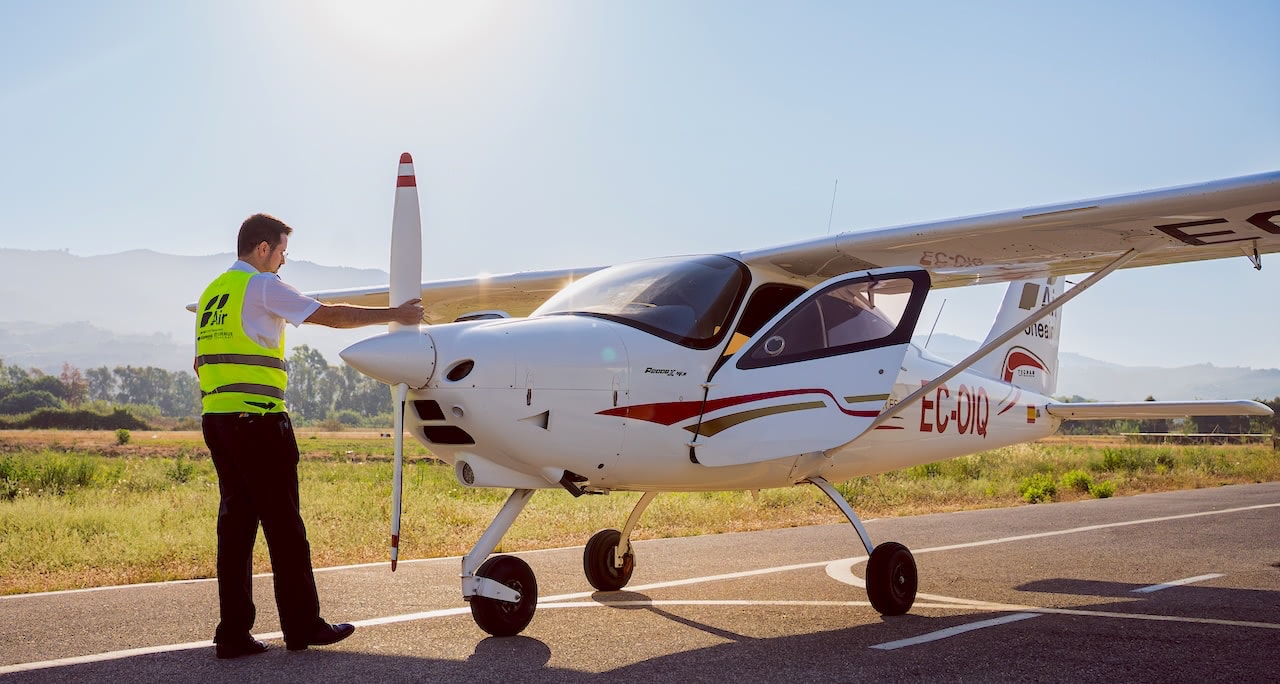
  • Systematic Pre-Flight Inspections: Rigorous walkarounds checking structural integrity, flight control deflection, fuel contamination, and weight-and-balance calculations.
  • Stabilized Approaches: Unwavering command over approach speeds, runway centerline tracking, and smooth flare control.
  • Energy & Ground Effect Management: Mastery of the flare sequence to prevent floating down the runway or hard landings caused by improper energy bleed-off.
  • Handling Contingencies & Procedural Focus: Immediate, calm execution of an aborted landing (go-around) or simulated engine anomalies during the departure phase.
  • Strict Weather Limitations: The solo flight is conducted solely under Visual Meteorological Conditions (VMC), avoiding gusty conditions or tight crosswind limits.

Step-by-Step Breakdown: How the First Solo Day Unfolds

The day of your solo flight typically starts like any regular pattern work session. This approach keeps student anxiety low and lets muscle memory take over.

1. The Pre-Check Dual Flight

You and your instructor take off to complete two or three standard traffic patterns together. If your airspeed control, trim, pattern altitude, and radio work are sharp and unhurried, the instructor instructs you to exit the runway and taxi to the apron.

2. Stepping Out of the Cockpit

With the parking brake set and the engine idling, your instructor unbuckles, disconnects their headset, and delivers a brief, calming de-brief. The instructor closes the door, confirms latch security, and heads to the ground station or ATC tower. You are now PIC.

3. Immediate Aircraft Performance Changes

Losing roughly 75 to 80 kg of instructor weight noticeably alters aircraft behavior:

  • Shorter Ground Roll: The aircraft accelerates faster and requires less runway before rotation speed.
  • Higher Rate of Climb: Vertical speed increases rapidly, reaching pattern altitude significantly faster.
  • Pitch Trim Sensitivity: With a lighter cabin load, the nose tends to rise more readily, requiring disciplined forward elevator pressure and proactive trim adjustments.

4. Flying the Visual Traffic Pattern

Navigating with visual checkpoints from the Visual Approach Chart (VAC), you fly the upwind, crosswind, downwind, base, and final legs. Inside the cockpit, your scan pattern stays disciplined: cross-checking engine temps and pressures, deploying flaps on schedule, and trimming for your designated approach speed.

5. Touchdown and Ramp Welcome

You establish a stabilized final approach, bring the power to idle over the threshold, float through the flare, and settle gently on the main gear.

After rolling out, vacating the runway, and executing your post-landing and engine shutdown checklists, the cabin quiet is unmistakable. On the ramp, instructors, ground crew, and fellow academy cadets will be waiting.

Aviation Solo Traditions Around the Globe

Completing your solo flight welcomes you into a proud global fraternity. Flight schools across Europe, North America, and beyond celebrate this rite of passage with deep-seated traditions:

The Solo Dunk (Water Bucket Baptism)

As soon as you step out of the cockpit, instructors and classmates drench you with buckets of cold water. Symbolizing a fresh start as an autonomous aviator, this tradition remains an iconic photo op at flight academies worldwide.

Cutting the Shirt Tail

Common across Anglo-Saxon and military-rooted schools, instructors take scissors to the back of the student’s shirt or tie.

This practice dates back to tandem two-seat trainers without onboard intercoms. The instructor sat behind the student and pulled the left or right shirt tail to direct turns.

Cutting off the shirt tail honors a pilot who no longer needs anyone tugging at their back to fly the plane. The fabric is dated, signed by the instructor, and hung in the student lounge.

Flight Training Progression After First Solo: Building PIC Time

The solo does not conclude training; in reality, it marks the beginning of the hour-building phase as Pilot in Command (PIC).

From this point forward, the student begins executing more complex solo flights, progressing steadily toward cross-country navigation between different airports, the demanding 300-nautical-mile triangular route, and, ultimately, the commercial pilot licence (CPL) skill tests.

Frequently Asked Questions About First Solo Flight

What happens if wind conditions change unexpectedly before takeoff?

Instructors monitor METAR and TAF reports up to the minute of departure. If surface gusts develop or crosswind limits exceed safe operating parameters, the flight is suspended. Flight safety always overrides scheduling.

Can a cadet decline to fly solo if they feel unready?

Yes. Aeronautical decision-making and self-assessment are fundamental safety pillars. If a student experiences fatigue or lack of confidence, the solo is postponed without consequence until the next suitable training block.

Are solo flights conducted in multi-engine aircraft or commercial jets?

Initial solos take place exclusively in single-engine piston training aircraft.

In multi-crew commercial airline operations (such as the Airbus A320 or Boeing 737), the transition to flying without an instructor is completed via Line Flying Under Supervision (LIFUS) alongside an airline training captain.

Build Your Commercial Airline Career in Southern Europe

Your first solo flight marks the transition from theoretical study to active cockpit leadership. Developing sharp stick-and-rudder habits early sets the foundation for your multi-engine instrument ratings and airline assessment preparation.

Based in Málaga, One Air provides international cadets with over 300 days of reliable VFR flight conditions per year in Southern Spain. Train on one of the most advanced Glass Cockpit fleet in Europe, supported by certified EASA simulation centers and dedicated student services designed for international aviators.

Contact our international admissions office to explore our EASA ATPL programmes and take command of your future.

You may be interested…