• Pilot Assessment: The Complete Guide to Acing Your Airline Selection

Obtaining your pilot license is a massive milestone—it’s the moment you’ve dreamed of since your first flight. But once the ink is dry on your license, the real challenge begins: landing that coveted first contract with an airline.

The pilot assessment process is the bridge between your flight school training and the right seat of an airliner. It is notoriously rigorous, designed to test far more than just your stick-and-rudder skills.

In today’s aviation industry, recruiters aren’t looking for “Top Gun” mavericks; they are hunting for resource managers, leaders, and professionals who stay cool under pressure.

Don’t panic. At One Air, we don’t just teach you to fly; we prepare you for your career.

In this guide, we’ll break down exactly what happens during an airline selection process and how you can prepare to secure your spot on the flight deck.

And if you are still in the preliminary research phase, you may want to take a look at the steps to becoming a commercial pilot before delving into the interviews.

What is the Pilot Assessment Process?

While every airline has its own specific corporate culture—from low-cost giants like Ryanair to legacy carriers like British Airways or Emirates—the core structure of the pilot assessment is remarkably similar worldwide.

Forget the idea of a simple job interview. This is a multi-stage evaluation that often spans several days. The airline’s goal is risk management. They need to verify that you are safe, trainable, and a good cultural fit for their operations.

Note: While this guide focuses on airlines, remember that there is several careers as a pilot, including cargo, business aviation, and aerial work.

EASA Standards and Requirements

Before you even step foot in the assessment center, your CV goes through a technical and “human” screening. To get invited, you must meet the EASA standards (or relevant authority requirements):

  1. Frozen ATPL License: You need a valid Multi-Engine (ME) and Instrument Rating (IR).
  2. Class 1 Medical Certificate: Non-negotiable evidence of your physical and mental fitness.
  3. English Proficiency: Legally, ICAO Level 4 is the minimum. However, in the international market, Level 5 or 6 is practically mandatory to stand out.
  4. APS MCC Training: Having an Airline Pilot Standards Multi-Crew Cooperation certificate is a game-changer. Airlines prioritize candidates who have completed an APS MCC because it proves you are already tuned into the multi-crew environment.

Technical Knowledge for the Commercial Pilot Selection Process

Once you pass the document check, the technical evaluation begins. This separates the candidates who memorized the question bank from those who truly understand the principles of flight.

ATPL Theory Refresh

Expect tests covering Navigation, General Knowledge, Meteorology, or Operational Procedures, among others.

In a real cockpit, you don’t always have time to fumble with an iPad. Recruiters want to see airmanship—an intuitive grasp of numbers. You might be asked:

“You are at FL300 and need to be at FL100 in 60 nautical miles. What is your required rate of descent?”

They aren’t looking for a calculator; they are testing your mental agility and your ability to apply “rules of thumb” quickly.

Psychometrics and Aptitude Testing

This is often the most feared stage, utilizing platforms like COMPASS, PILAPT, or Cut-e. These computer-based tests are designed to load your brain to the breaking point to measure your cognitive resilience.

They evaluate:

  • Hand-Eye Coordination: Tracking a moving object on a screen with a joystick.
  • Spatial Awareness: Instantly visualizing aircraft orientation based on instrument readings.
  • Multitasking Capacity: Solving logical patterns while simultaneously memorizing a sequence of numbers heard through headphones.

It sounds intense because it is. They want to see if you can maintain situational awareness when the workload spikes.

The Simulator Check

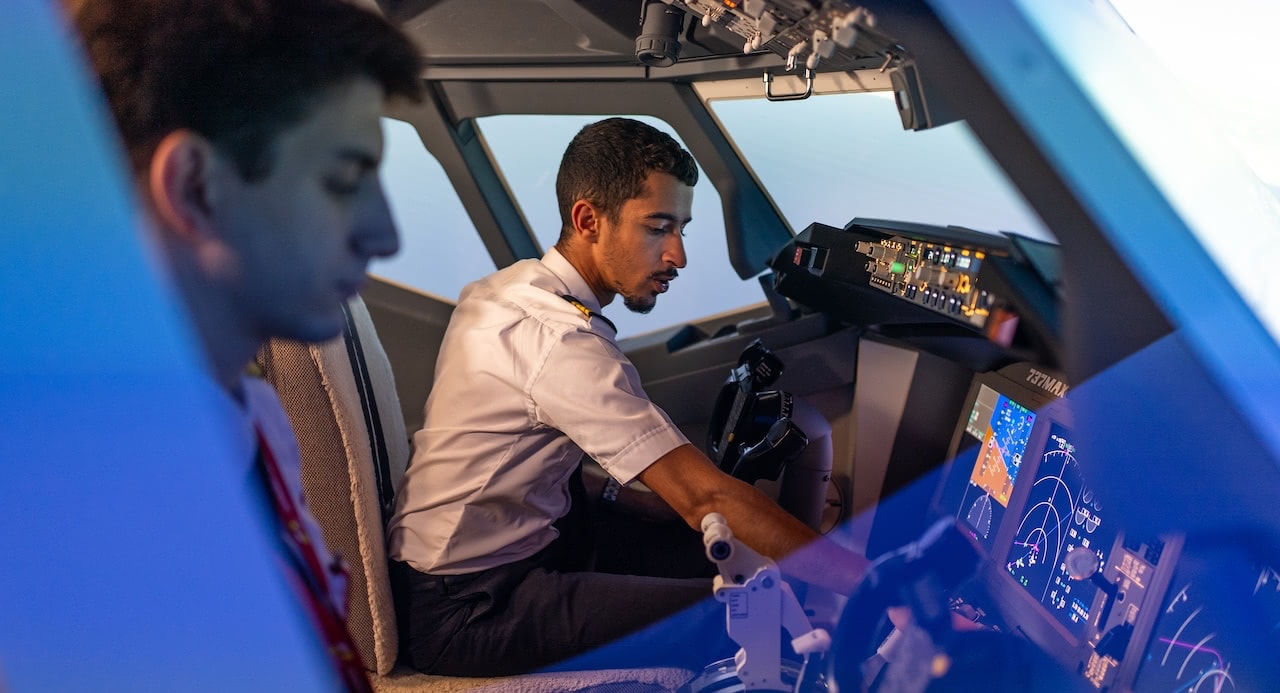
Usually conducted in a generic jet simulator (like a fixed-base Boeing 737 or Airbus A320), the “Sim Check” is about potential, not perfection.

If you aren’t type-rated, they don’t expect you to fly the jet perfectly. What they are analyzing is your learning curve. If you deviate from your altitude or mess up a radial interception, do you freeze? Or do you acknowledge the error, correct it calmly, and move on?

Key tip: Adherence to Standard Operating Procedures (SOPs) and effective communication are more important here than a perfect landing.

We offer three specific programmes to become a commercial pilot. Choose yours!

How to Prepare for a Commercial Pilot Assessment

You’ve proven you can fly; now you must prove you can work with others.

Group Exercises & CRM

In the group dynamic stage, you will be given a problem to solve with other candidates (often non-aviation related, like a survival scenario).

Psychologists and captains will observe your CRM (Crew Resource Management) skills. They are looking for:

  • Active Listening: Do you actually hear what others say?
  • Conflict Resolution: Can you disagree without being aggressive?
  • Facilitation: Do you help quieter members of the group speak up?

Pro Tip: Don’t try to be the “Alpha”. The best airline pilot is often the one who facilitates the team to reach the best decision, not the one who shouts the loudest.

The Competency-Based Interview

If you make it to the final interview, congratulations. They know you can fly. Now they want to know who you are.

Modern airline interviews use the STAR Method (Situation, Task, Action, Result). Instead of asking “Are you responsible?”, they will ask:

“Tell me about a time you had to make a difficult safety decision. What happened and what was the outcome?”

Be honest about your weaknesses. A pilot who claims they never make mistakes is considered a safety risk. Airlines want self-awareness and integrity.

How to structure your answer:

  1. Situation: Briefly set the scene.
  2. Task: What was required of you?
  3. Action: What did you specifically do?
  4. Result: What was the outcome and what did you learn?

Passing this final stage is not only a professional triumph, but also opens the door to one of the most highly regarded professions. In fact, you can check here to see how much an aeroplane pilot currently earns to get an idea of the market situation.

Why Quality Training Matters More Than Ever

The aviation market is cyclical, but the demand for high-quality training is constant. According to market outlooks from major manufacturers like Boeing and Airbus, the industry is facing a historic demand for new professionals over the next decade.

At One Air in Málaga, we understand that your goal isn’t just a license—it’s a career. That’s why our training is focused on airline readiness from day one. We train you to pass the pilot assessment, not just the flight test.

The pilots selection process is tough, but with the right preparation, it is entirely achievable. If you are looking for a flight school in Southern Europe that combines perfect flying weather with rigorous airline-standard training, we are here to help.

Contact One Air today and let’s discuss how we can get you from zero to the cockpit.

You may be interested…