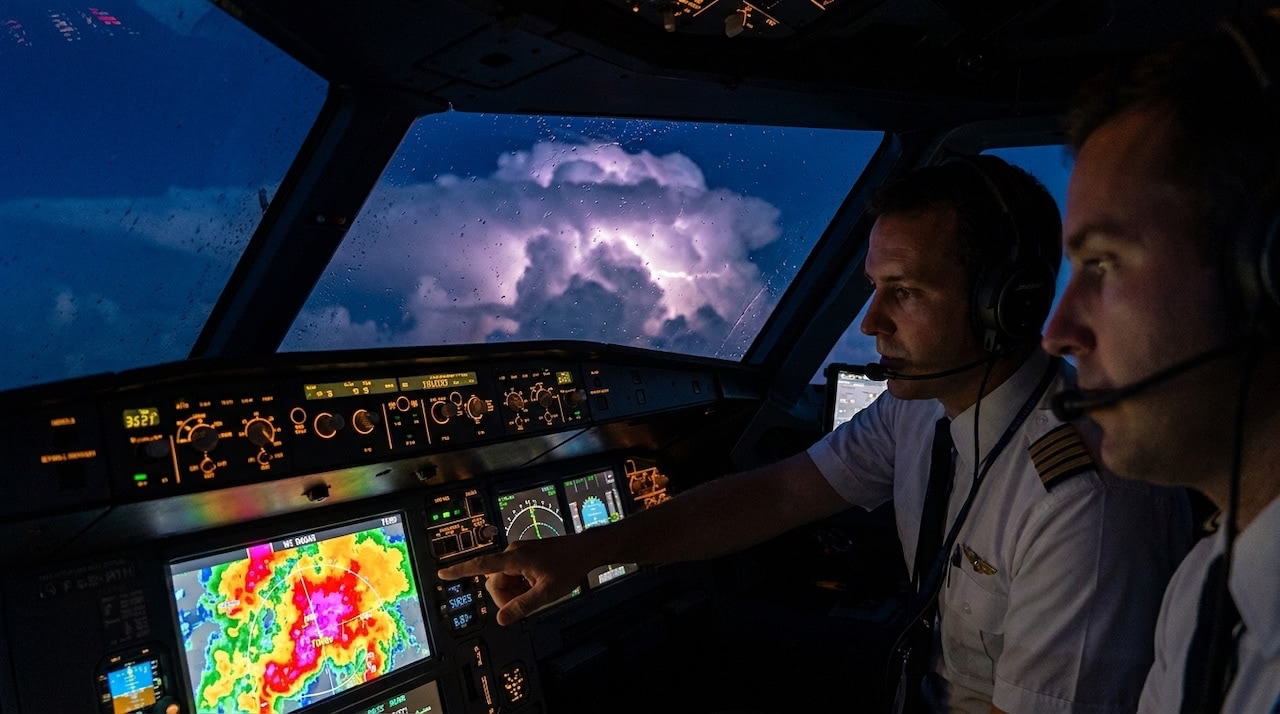
• Lightning Strikes on Aircraft: What Happens If a Plane Is Struck by Lightning?

During the operational lifespan of any commercial airliner, a plane hit by lightning is neither a freak accident nor an unforeseen emergency; it is a known meteorological variable meticulously accounted for from the earliest stages of structural design and aerospace certification.

For aspiring pilots, understanding the engineering behind an airplane struck by lightning is esential to fully grasp modern safety standards.

In this article, we break down the applied physics and operational protocols that ensure lightning strikes on aircraft are managed with absolute safety, keeping millions of volts of atmospheric electricity completely under control during flight.

Operational Risk Management:

Can You Fly in a Thunderstorm?

When future aviation students ask whether airplanes fly in thunderstorms, the answer is technically yes, but it is always subject to strict meteorological planning and severe weather avoidance. In aviation, safety is never left to chance.

To assess if it is dangerous to fly during a storm, flight crews analyze operational risks that go far beyond the electrical discharge itself. The real operational challenge when navigating an airplane in a thunderstorm lies in the extreme wind gradients, microbursts, severe windshear, and powerful convective updrafts and downdrafts churning inside cumulonimbus clouds.

To manage these scenarios efficiently, modern aircraft utilize nose-cone-mounted Doppler weather radars. These systems measure precipitation reflectivity, mapping out storm cells hundreds of miles ahead so pilots can proactively chart safe diversion routes.

Nevertheless, because the atmosphere is dynamic, EASA CS-AWO regulations mandate that all commercial aircraft must be certified to withstand direct lightning strikes without sustaining structural damage that could compromise the continuation of the flight.

APPLIED PHYSICS:

The Aircraft as a Faraday Cage

To understand exactly why aircraft are virtually immune to catastrophic electrical damage, we must look to the fundamental laws of classical electrostatics, specifically the application of the Faraday cage on an airplane.

When a lightning strike hits an airplane in mid-air, the outer aluminum fuselage (or the conductive mesh embedded within composite structures) acts as a highly efficient path of least resistance. According to the laws of physics, like charges repel each other, distributing themselves exclusively along the outer “skin” of the aircraft.

This electrostatic equilibrium ensures that the net electric field inside the passenger cabin, cargo holds, and avionics bays remains at zero. Consequently, all critical systems and internal elements are completely isolated from the current.

The Shift to Composite Materials vs. Traditional Aluminum

In modern aerospace engineering, the transition from traditional aluminum to composite materials, such as Carbon Fiber Reinforced Polymers (CFRP), has revolutionized aircraft fuel efficiency by drastically reducing structural weight.

However, since carbon fiber lacks the high natural electrical conductivity of pure metals, manufacturers integrate an extremely fine layer of expanded copper mesh (MEC) or aluminum wire directly beneath the exterior paint.

This design ensures that the aircraft’s shielding properties against a lightning strike remain uncompromised.

Comparison table of different aircraft construction materials.
Structural MaterialElectrical ConductivityBehavior Under Electrical DischargeWeight & Efficiency
Traditional AluminumExcellent (natural conductor).Immediate dissipation of energy across the structure. Minimal risk of localized thermal pitting.Higher structural weight; lower long-term fuel efficiency.
Carbon Fiber (CFRP) with meshNaturally low (High via superficial metalization).The integrated mesh absorbs and diverts the current, protecting internal resins and preventing delaminationSignificantly lower; maximizes fuel economy and aircraft range.

So, What Happens When Lightning Strikes an Airplane?

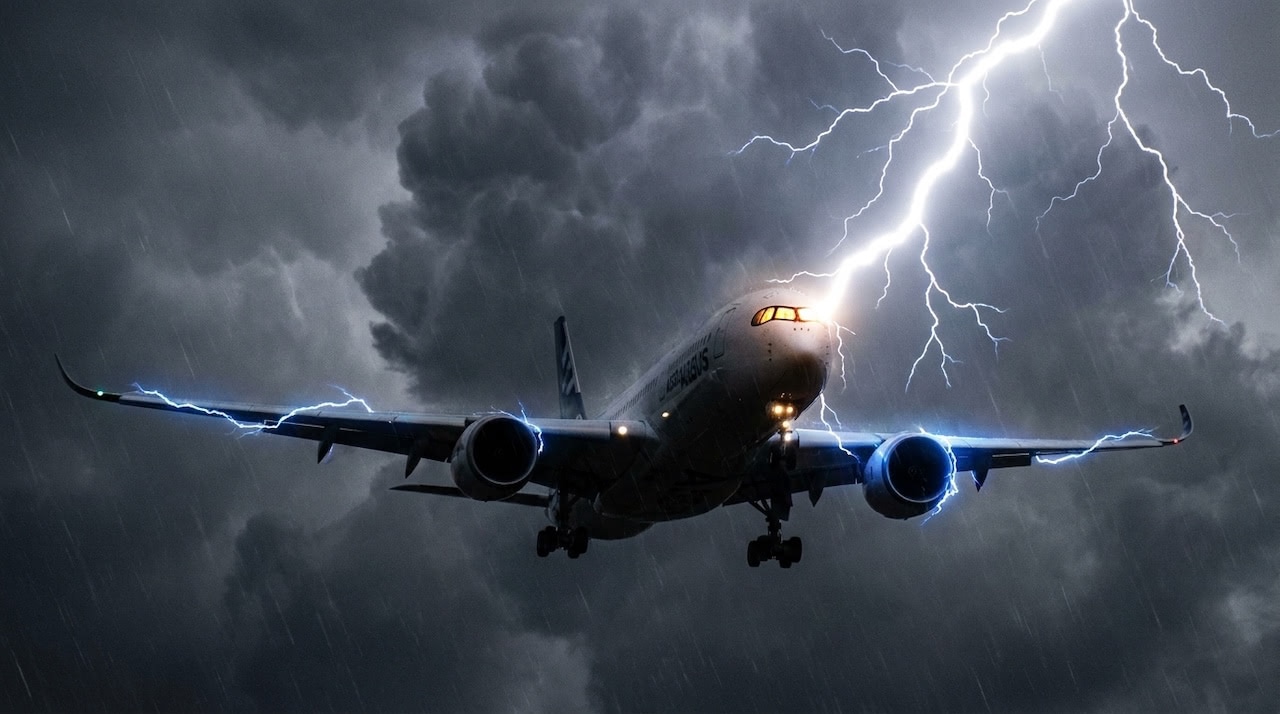
The physical process of a lightning bolt hitting a plane lasts only a fraction of a second. Strictly speaking, the aircraft does not actively “attract” the lightning like a ground-based lightning rod; rather, as it flies through an area of high potential difference, the airframe simply provides a path of far lower electrical resistance than the surrounding air.

The movement of the discharge across the airframe follows a dynamic principle known as a swept stroke, which unfolds in three distinct phases:

  1. Initial Attachment Point: The lightning leader typically attaches to the most exposed, pointed extremities of the fuselage, such as the nose cone (radome) or the wingtips.
  2. Surface Sweeping: As the aircraft moves forward at hundreds of knots, the lightning channel slides discontinuously along the outer skin without penetrating the cabin.
  3. Discharge Point: Finally, the current seeks its natural exit to continue its path back to the atmosphere or down to the ground, usually detaching from the tail empennage or trailing edge stabilizers.

Just before the electrical arc fully consolidates, flight crews often witness an intermittent bluish or violet glow on the cockpit windshield. This visual phenomenon is known as St. Elmo’s Fire, a luminous corona discharge caused by the intense ionization of air molecules under extreme electrical fields.

Furthermore, to prevent the friction of air and ice crystals from dangerously charging the airframe during routine flight, aircraft are equipped with static wicks along the trailing edges of the wings.

These small rods continuously bleed static electricity back into the atmosphere, preventing it from saturating the fuselage, protecting communication antennas, and minimizing interference across VHF and HF radio frequencies.

The Post-Impact Maintenance Protocol in Commercial Airlines

While passive protections successfully mitigate in-flight risks, commercial aviation demands rigorous engineering protocols once the aircraft returns to the ground.

When an airliner experiences a strike, the flight crew formally logs the event in the aircraft’s technical logbook. Immediately upon landing, line maintenance crews initiate a mandatory Lightning Strike Inspection.

During this procedure, maintenance engineers meticulously evaluate two distinct types of phenomena:

Direct Effects

A physical and visual examination of the exterior skin is conducted to pinpoint entry and exit attachment points. Inspectors search for minor localized melting on metal surfaces, affected rivets, or minor thermal discoloration of the paint.

Indirect Effects

Dedicated diagnostic tests are run on the avionics suites. Technicians verify that the transient electromagnetic fields induced by the high-current discharge have not caused any intermittent faults within the flight computers, data buses, or navigation systems.

To inspect state-of-the-art composite structures without causing damage, airlines utilize advanced Non-Destructive Testing (NDT) techniques, such as ultrasonic scanning or Eddy Current testing. These tools are capable of detecting micro-delaminations hidden deep within the carbon fiber layers.

Only when certified inspectors verify flawless electrical continuity and structural integrity is the aircraft granted its Release to Service (RTS).

Frequently Asked Questions About Lightning Strikes on Airplanes (FAQ)

Can a lightning strike cause a total engine failure?

This scenario is extremely remote. Modern jet and turboprop engines feature comprehensive electromagnetic shielding. Their Full Authority Digital Engine Control (FADEC) units operate independently from the aircraft’s primary electrical grid, ensuring uninterrupted engine operation even during severe atmospheric discharges.

Do cockpit instruments shut down during a thunderstorm?

No. Flight decks, navigation systems, and communication equipment are heavily shielded and certified to withstand High-Intensity Radiated Fields (HIRF).

Additionally, aircraft architecture features redundant power distribution networks, emergency backup generators, and independent batteries to ensure flight data remains uninterrupted.

How often do lightning strikes hit commercial airplanes?

Civil aviation statistics show that, on average, every commercial airliner in scheduled service is struck by lightning approximately once a year, or once every 1,000 flight hours. It is an entirely standardized operational event for which modern aerospace engineering is fully prepared.

What technical checks are performed after landing?

Engineers follow a structured protocol outlined in the manufacturer’s Aircraft Maintenance Manual (AMM). They map out the entry and exit points, test the continuity of the superficial conductive mesh, and run full systemic software diagnostics before clearing the aircraft for its next line flight.

The Key is Mastering Meteorology

Managing adverse weather conditions and understanding the physics of flight requires top-notch academic and technical training. And now that you know the real science behind these atmospheric phenomena, you understand why operational safety is never left to chance.

At One Air, three-time winner of the Best Flight School in Spain award, we provide you with all the resources you need to turn your passion into a successful career.

Learn more today about our three ATPL Commercial Pilot Course programs. Take the definitive leap and take off with us toward your future in the airline industry.

You may be interested…