
• Airbus A380 Aircraft: Engineering Marvel & The Path to the Cockpit

Have you ever stood at the base of an eight-story building and imagined making it fly? For a pilot, the first time you do a walk-around under the wing of an Airbus A380, the feeling is absolute disbelief.

Regardless of whether you are “Team Boeing” or a die-hard Airbus fan, the aviation world agrees on one thing: the A380 is a masterpiece of modern engineering.

Are you curious about this colossus of the skies? Fasten your seatbelt. Today, we are taking a deep dive into the A380 aircraft, the ‘Superjumbo’ that redefined luxury at 40,000 feet, and how aspiring pilots prepare to handle machines of this magnitude.
What is the World’s Largest Passenger Aircraft?

It’s the million-dollar question, and the answer is definitive: The Airbus A380 remains, indisputably, the largest passenger airliner on the planet.

However, depending on the criteria used, there can be some confusion in the aviation community. Let’s look at the data:

CAPACITY

The A380 holds the absolute record. While airlines typically configure it for 500–550 passengers (to make room for onboard bars and suites), its type certificate actually allows for up to 853 passengers in a single-class configuration. Imagine coordinating the boarding procedure for nearly a thousand people on one flight!

VOLUME

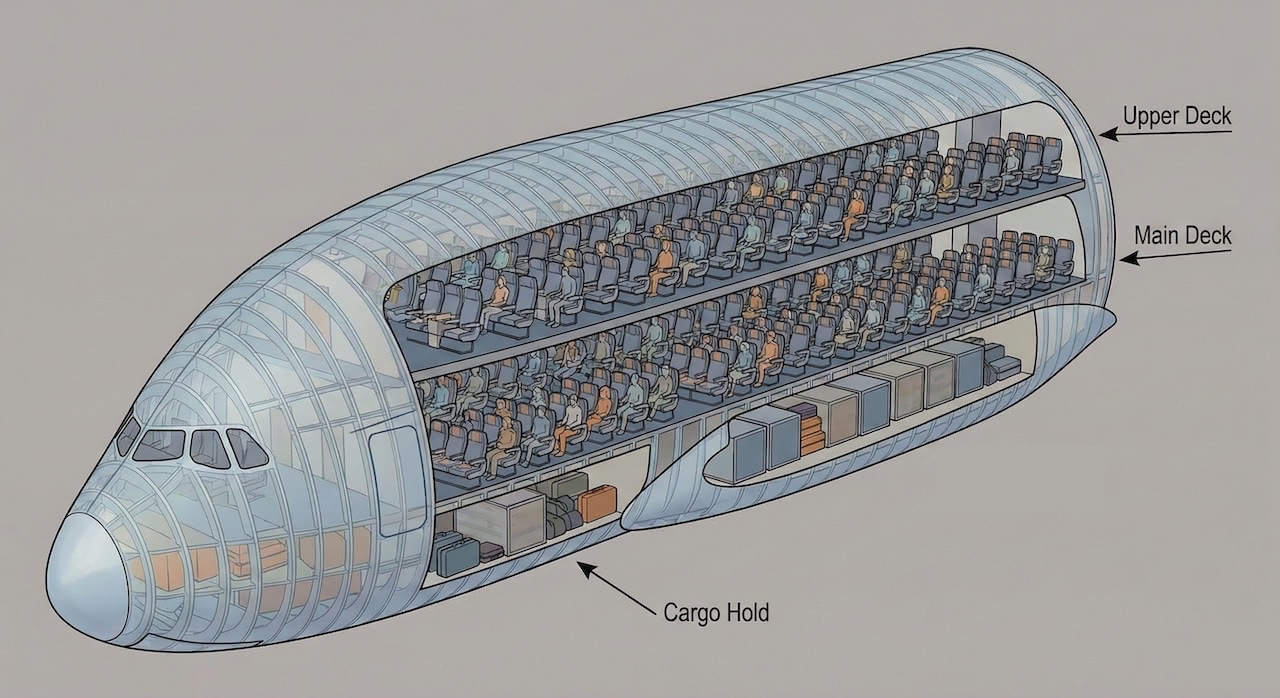
It is the only commercial aircraft with a full double-deck extending the entire length of the fuselage, offering 40% more usable floor space than the Boeing 747-8.

But what about the Antonov or the Boeing 777X?

  • The Antonov An-225 Mriya (sadly destroyed) was heavier and larger, but it was a pure freighter, not a passenger jet.
  • The new Boeing 777-9 is technically longer (76.7 meters vs. the A380’s 72.7 meters), but it is a single-deck twin-engine jet. It wins on length, but the A380 wins on volume and total capacity.

A380 Engineering: Beyond the Size

When discussing the A380 aircraft, the statistics are dizzying, but what really impresses pilots is how those numbers translate to performance in the air.

This giant isn’t big just for the sake of it; its full double-decker design was Europe’s answer to the historic dominance of the Boeing 747.

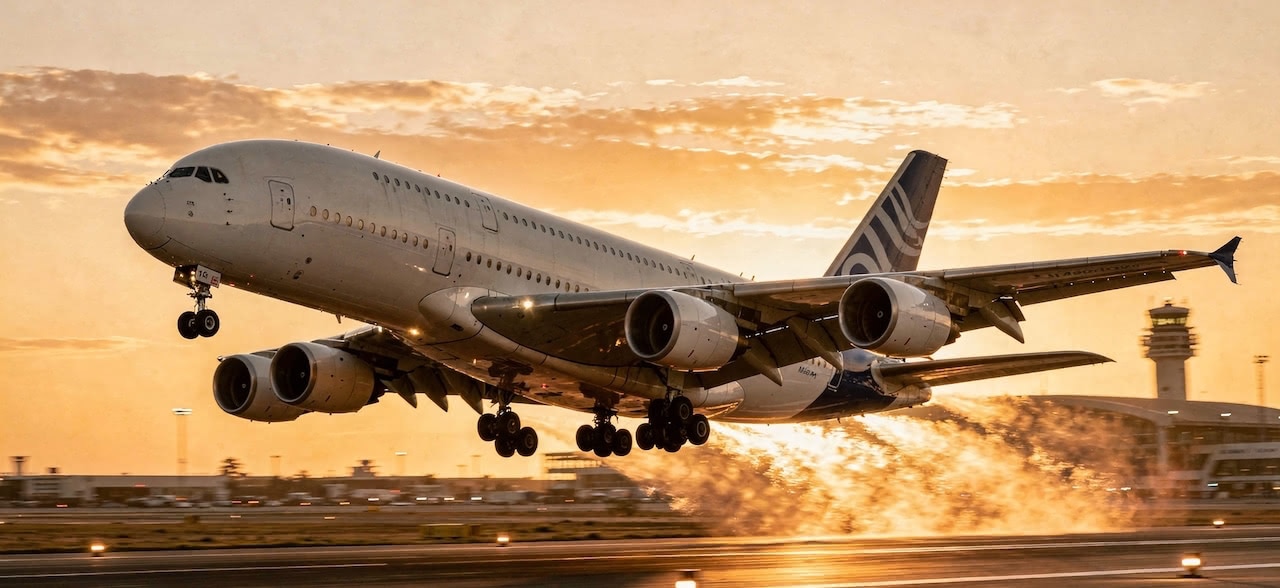
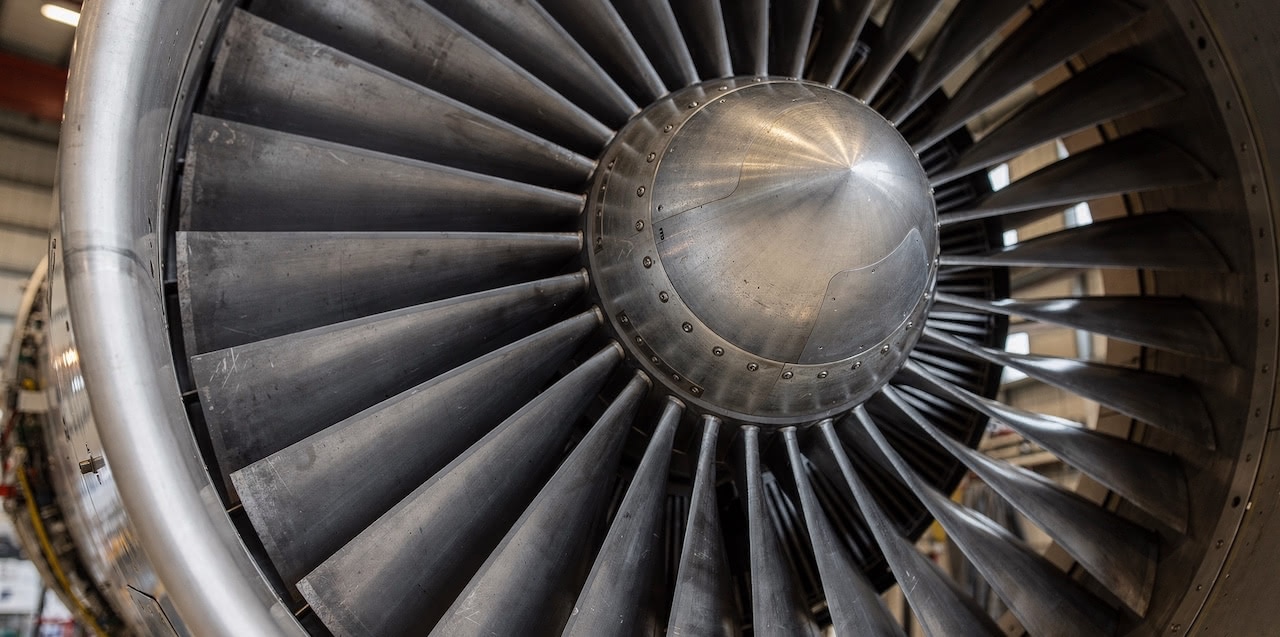
To lift its massive 575-tonne Maximum Take-Off Weight (MTOW), the A380 relies on four high-performance engines, typically the Rolls-Royce Trent 900 (you can actually see one displayed here at the Málaga Aeronautical Museum) or the Engine Alliance GP7000.

Despite its size, the A380 is surprisingly “light” for its volume. Airbus implemented GLARE (Glass-Reinforced Aluminium Laminate) on a large scale for the first time—a hybrid material resistant to fatigue and corrosion, and 10% less dense than traditional aluminum.

Key Specs of the Superjumbo

To give you a sense of scale:

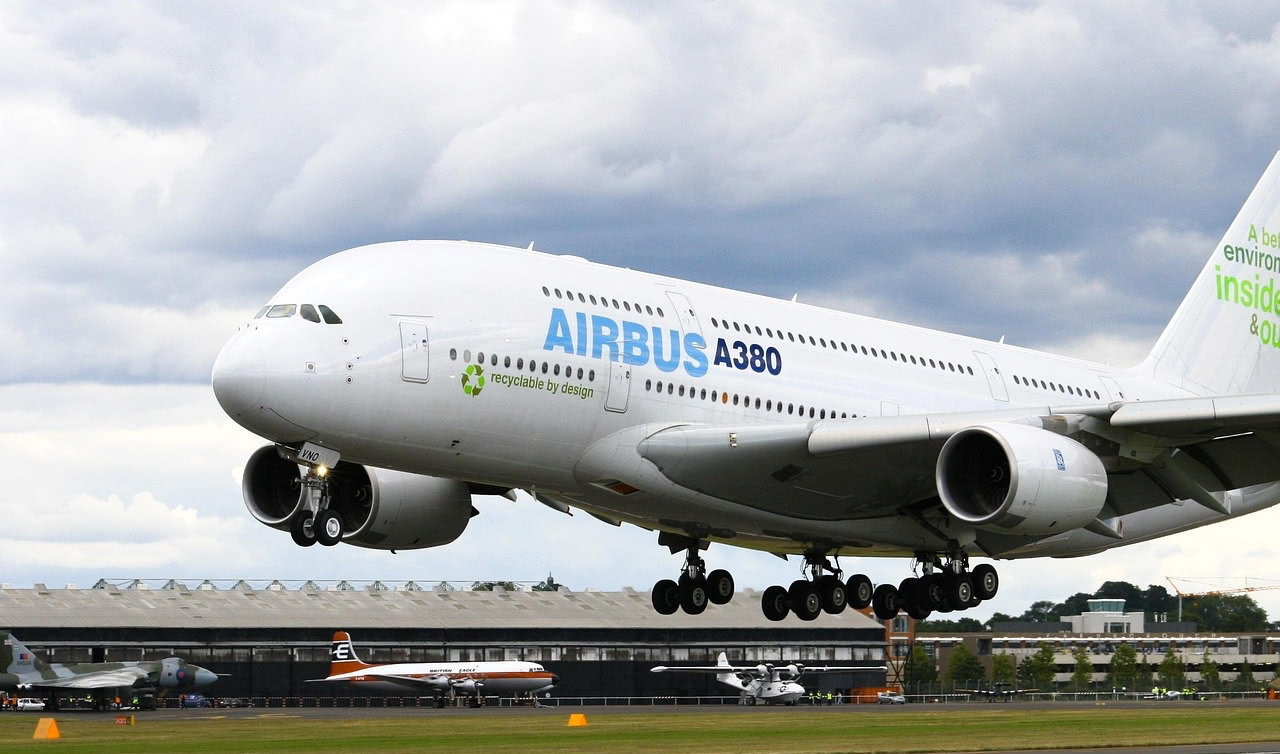
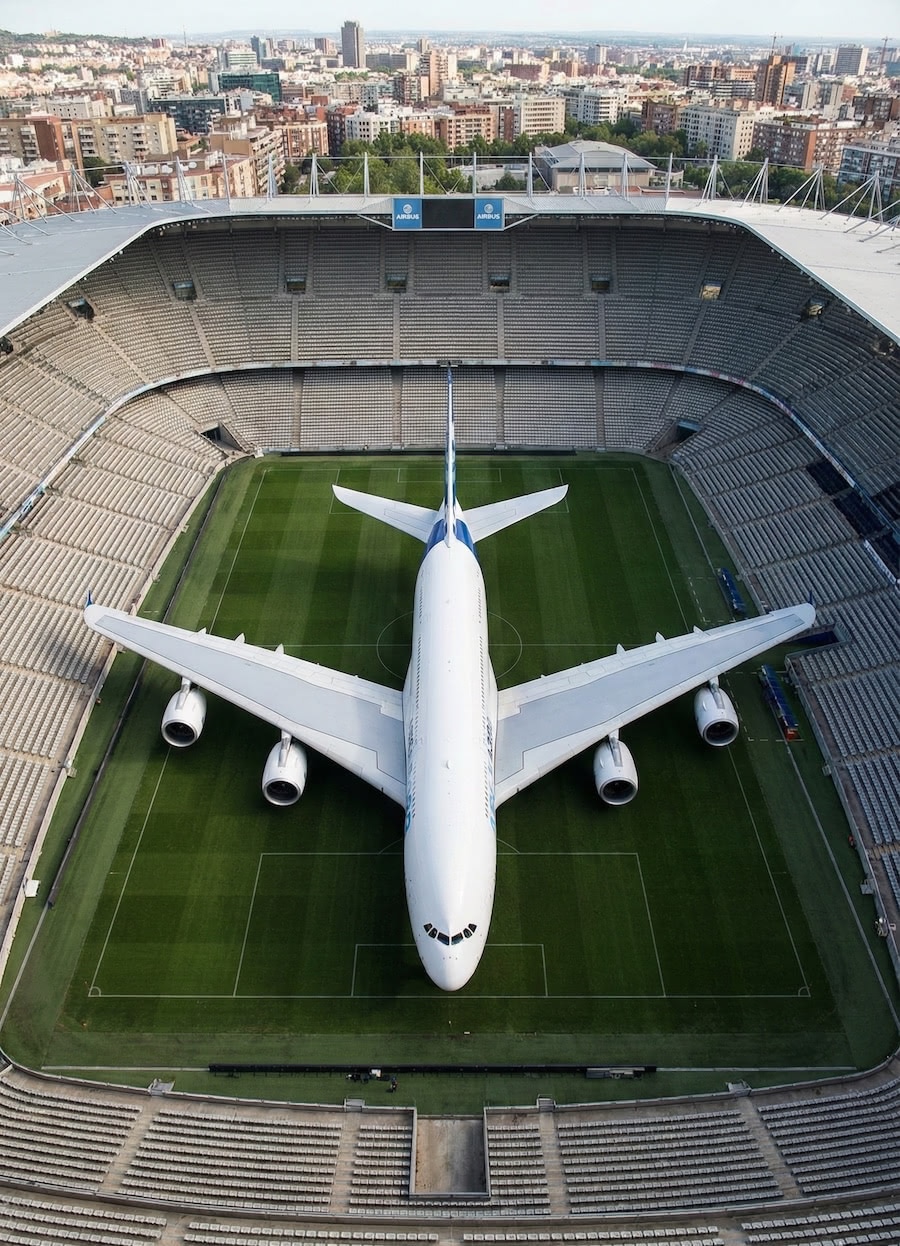
  • Wingspan: 79,8 meters. If you parked an A380 inside Málaga’s La Rosaleda football stadium, the wings would nearly touch the stands on both sides.
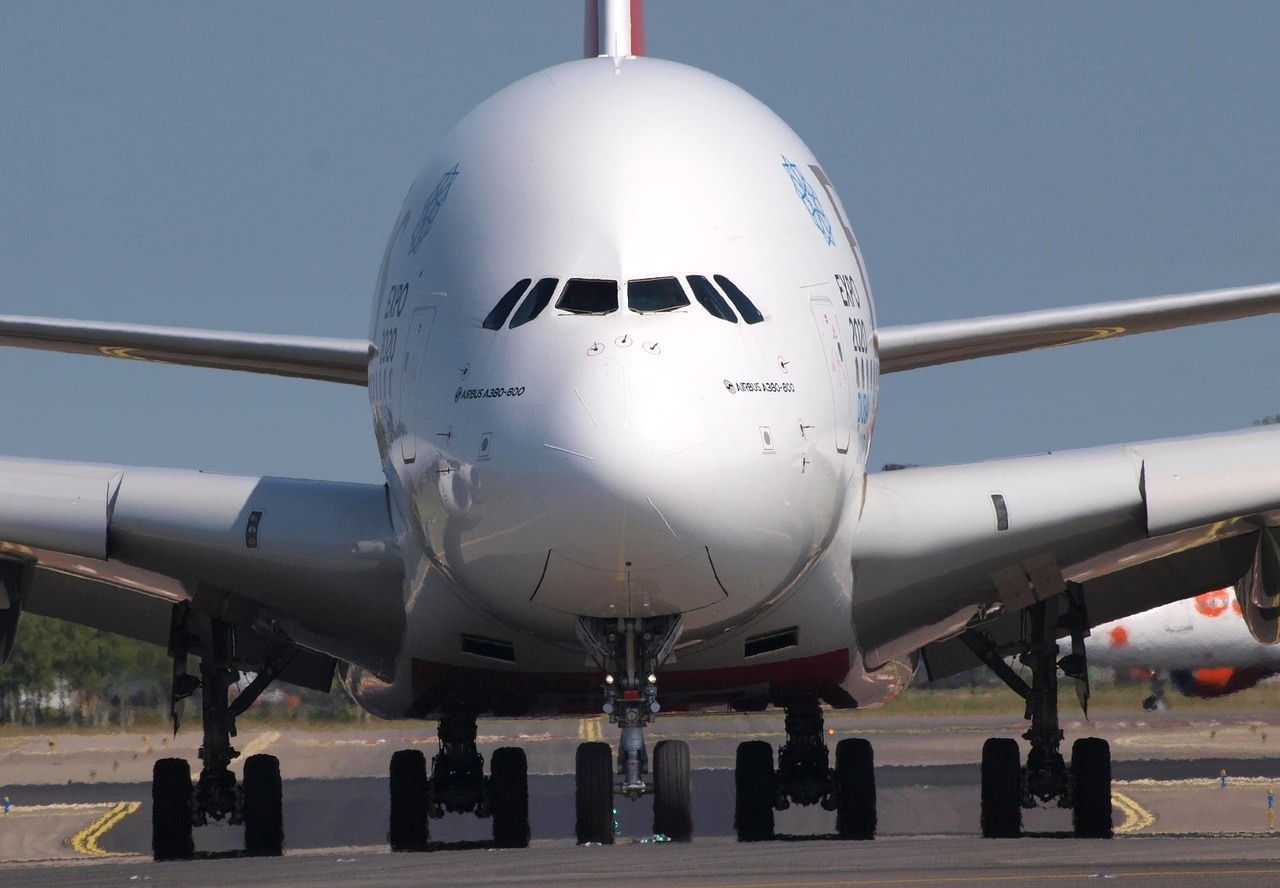
  • Height: 24,1 meters (equivalent to an 8-story building).
  • Fuel Capacity: 85,471 gallons. (Enough to fill the tanks of about 6,500 average cars).
  • Landing Gear: 22 wheels distributed across 5 struts to distribute the weight and protect the runway surface. Tire pressure reaches 220 psi (compared to your car’s 30–35 psi).

Pilot’s Note: Despite its mass, the A380 is incredibly quiet in the cockpit and remarkably stable during turbulence due to its high inertia and massive wing surface area.

Titans of the Sky: A380 vs. Boeing 747 and 777

How does the Superjumbo stack up against the original ‘Queen of the Skies’ and the future of twin-engine aviation?

Comparison between the Airbus A380, the Boeing 747-8 and the 777.
Airbus A380-800
(The Superjumbo)
Boeing 747-8i
(The Queen)
Boeing 777-9
(The Future)
ConfigurationQuad-jet (2 full decks)Quad-jet (1.5 decks)Twin-jet (1 deck)
Typical Pax550410426
Wingspan79.8 m68.4 m71.8 m (Folding tips)
Max Weight (MTOW)575 t447 t351 t
Engines442 (GE9X – World’s largest jet engine)
EfficiencyHigh (if full)MediumVery high

Inside the A380: A Hotel in the Clouds

Enough with the specs—let’s talk passenger experience. The interior is where the A380 aircraft truly changed the game.

Unlike single-aisle aircraft (as discussed in our guide to aircraft types), the A380’s wide-body fuselage allows for layouts that seem like science fiction. Generally, the Upper Deck is reserved for Premium classes, while the Main Deck maximizes economy comfort.

The Emirates Experience

If one airline transformed this aircraft into an icon, it is Emirates. Their A380 fleet raised the global standard with features previously thought impossible:

  • Shower Spas: First Class passengers can shower at 38,000 feet. It requires carrying tonnes of extra water, but the marketing impact is priceless.
  • Onboard Lounge: A full bar at the rear of the aircraft for Business and First Class socialising.
  • Private Suites: Fully enclosed seats with sliding doors.

Why Did Production Stop?

Despite being a technological marvel, A380 production ended in 2021. Why? The paradigm of commercial aviation shifted.

The industry moved from the Hub-and-Spoke model (flying everyone to a massive central airport like Dubai or London on a huge plane, then connecting) to the Point-to-Point model (direct flights between smaller cities).

For direct routes, modern twin-engine jets like the Airbus A350 or Boeing 787 Dreamliner are far more fuel-efficient and easier to maintain than a four-engine giant.

However, the A380 isn’t going anywhere soon. Airlines like Emirates, British Airways, Lufthansa, and Singapore Airlines will continue operating them for the next decade, as their capacity for high-density routes is unmatched.

Frequently Asked Questions (FAQ)

How many passengers can an A380 aircraft actually carry?

Although the typical capacity is around 525 people in three classes, the aircraft is certified to carry up to 853 passengers if configured entirely in economy class.

Is the A380 difficult to fly?

Surprisingly, thanks to Airbus’s advanced Fly-by-wire technology, handling the A380 is procedurally very similar to an A320. The main challenge for pilots is managing its sheer physical dimensions on the ground (taxiing) and energy management due to its immense mass.

How much does an A380 cost?

The last list price before production ended was approximately $445 million USD.

How safe is the A380 aircraft?

It is one of the safest aircraft in aviation history. Since entering service in 2007, the A380 has never recorded a hull loss with fatalities, proving the robustness of its design and systems.

What is the cruising speed?

Its typical cruise speed is Mach 0.85 (approx. 1,050 km/h), though it is capable of higher speeds if required.

From Zero to Airline Cockpit: Your Journey Starts Here

Every A380 Captain started in the same place: a single-engine piston aircraft. The key to reaching the flight deck of a wide-body jet is training with the right technology.

At One Air, based in sunny Málaga, Spain, we operate one of the largest and most modern fleets in Europe. We focus on Glass Cockpit technology, equipping our aircraft with Garmin G1000 NXi and G3X Touch avionics.

Why does this matter? You will learn to manage digital displays, synthetic vision, and advanced automation from your very first flight hour. This makes the future transition to an airliner—where everything is digital—seamless and natural.

Furthermore, our SimLab by One Air is the largest simulation center in a European ATO. You will train on simulators for the Airbus A320, Boeing 737-800 NG, and the Boeing 737 MAX.

The Best Place to Train in Europe

Combining this state-of-the-art tech with Málaga’s exceptional climate (allowing for over 300 flying days a year) means you finish your EASA license faster and more efficiently than in Northern Europe.

Looking at an Airbus A380 from the terminal is awe-inspiring. But looking at it from the tarmac, knowing you have the license, the training, and the technical skill to command it… that is a feeling words cannot describe.

The cockpit is ready. Are you? Request Information about our EASA Commercial Pilot Courses and book your place now!

You may be interested…